


A trusted knitwear manufacturer
A trusted knitwear manufacturer empowering your brand expansion.
Start your brandjourney today.

Tue 10 , 2026

A customer picks your hoodie off the rail. Before they try it on, they have already read three things: the brand name stitched inside the collar, the hang tag, and the bag it came out of. None of those are the garment. All three decide whether it reads as a mass-market label or a premium one.
Labels and packaging are the cheapest part of a private label order and the part most often left to the last minute. That ordering is backwards. A woven label has to be woven, a hang tag has to be printed, and both have to arrive at the sewing floor before the first garment is finished. If you start these conversations after bulk production begins, you will either ship with the factory's stock labels or delay the whole order.
Buyers use "label" loosely. In production, five different items get called a label, and they are ordered from different suppliers at different times. When brands ask us to quote custom clothing labels, they usually mean two of them: the brand label in the neck and the care label in the side seam.
| Item | Where It Sits | Its Job |
|---|---|---|
| Brand label | Centre back neck, inside | Carries your logo and brand name |
| Care and content label | Inside side seam | Fibre content, origin and washing instructions |
| Size label | Below the brand label or in the side seam | Size designation for the market you are selling into |
| Flag tag | Side seam, hanging outward | Small folded tag with the logo or a short slogan |
| Hang tag | Attached to the garment at retail | Price, barcode, size, brand story |
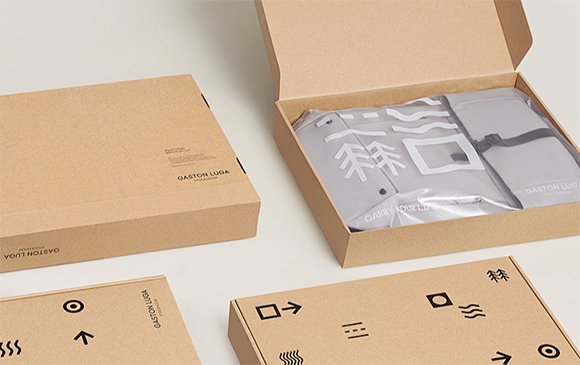
A private label clothing packaging order is a separate list: the polybag the garment is folded into, the tissue paper or sticker inside it, and the mailer or gift box for direct-to-consumer orders. We produce accessories and packaging alongside the garment through our own custom apparel production process, which is why a first order can ship with your labels already sewn in rather than arriving plain and needing a second trip.
Choose woven when the label is part of the brand and will be read up close. Choose printed when you need fine detail, small text or many colours, and when the label is a legal care label rather than a design element. Choose heat transfer when the garment is sheer or lightweight and a sewn label would show through or scratch. Choose a leather or faux-leather patch when the product is a cap, a denim jacket or anything workwear-adjacent. Choose satin when the budget is tight and the label sits against the skin.
| Label Type | How It Is Made | Strengths | Limits |
|---|---|---|---|
| Woven | Threads woven into the design on a loom | Premium feel, does not fade, unlimited washes | Small text and fine gradients are hard to weave |
| Printed (satin or cotton) | Ink printed onto a ribbon, then cut and folded | Cheapest, sharp detail, multi-colour and small type | Print can wear with repeated industrial washing |
| Heat transfer | Printed film pressed onto the fabric | No stitching, invisible from outside, very light | Can lift at the edges on stretch fabric |
| Satin | Woven or printed on smooth satin ribbon | Soft against the skin, low cost, good for care labels | Feels less substantial than woven |
| Leather or faux-leather patch | Debossed, embossed or stitched patch | Strong visual statement on caps and outerwear | Heavier, higher cost, not suitable for lightweight knits |
Most brands end up with two: a woven brand label in the neck and a printed care label in the side seam. That pairing gives you the premium feel where it is seen and the fine print where it is legally required.
This is the part that is not a design decision. In the United States, the FTC requires fibre content, country of origin and either care instructions or a warning that the item should be washed before use. In the EU, the fibre composition must be listed in descending order by weight, and care symbols follow the ISO 3758 standard. Getting this wrong is not a branding problem; it is a compliance one, and it can stop a shipment at customs.
Practically, that means the care label has to be locked before the fabric is finalised, because the fibre percentages come from the fabric, not from your design. If you switch from a 100% cotton jersey to a 60/40 blend mid-project, the care label changes with it. Order the care labels after the fabric is confirmed, not before.
A clothing label manufacturer asks for the same handful of details every time. Sending them in one message instead of five avoids a week of back-and-forth.
| Field | Example | Why It Matters |
|---|---|---|
| Label type | Woven, damask weave, both sides | Determines cost, lead time and how fine the detail can be |
| Size in millimetres | 30 × 50 mm, folded centre | Width is capped by the neckline opening |
| Fold | Centre fold, end fold or straight cut | Wrong fold means the label will not sit flat when sewn |
| Colours and thread | Pantone references, ground colour, thread type | Thread colour affects both look and cost |
| Backing and finish | Soft backing, laser-cut edges, heat-seal | Rough edges scratch; this is a comfort decision |
| Quantity per size | 600 total, 150 each of XS–L | Size labels are usually ordered per size, not per style |
One detail that catches people out: size labels are counted per size, not per garment type. If you order 600 tees across four sizes, you need 150 of each size label, not 600 of one. The same applies to custom hang tags with the size printed on them.
Packaging splits into two jobs. Wholesale packaging has to protect the garment and carry a barcode. Direct-to-consumer packaging has to survive a courier and create an unboxing moment. Most brands need both, because the same style sells through a stockist and through their own store.
| Option | Best For | What to Watch |
|---|---|---|
| Polybag with size sticker | Wholesale and stockist orders | Some markets now restrict single-use plastic; ask for a recycled or paper option |
| Printed hang tag | Retail and marketplace listings | Barcode and size must match the label inside the garment |
| Tissue paper and sticker | DTC orders, gifting | Adds a fold step, so it needs to be planned into packing time |
| Branded mailer or gift box | Launch drops and premium price points | Bulky items raise freight cost more than the box itself costs |
| Woven or printed tape and seals | Any unboxing-led brand | Cheap to add and it is the first thing the customer photographs |
We source zippers, buttons, drawcords and trims through the same channel as the labels, so a single order can include the garment, its branding and its packaging. Using one clothing packaging supplier for all of it removes the classic failure where the garments are finished, the labels are still on a boat, and the launch slips three weeks.
Less than most first-time brands expect, provided the quantities make sense. The figures below are the pattern we see on private label orders; the exact number depends on label type, colour count and whether the packaging is stock or custom.
| Order Size | Cost Pattern | What Drives It |
|---|---|---|
| Under 500 pcs | Highest per-unit label cost | Weaving and printing have their own minimums; you pay for unused capacity |
| 500–2,000 pcs | Cost falls sharply | Most label minimums are cleared; you move to a realistic unit price |
| 2,000+ pcs | Low and stable | Driven by label size, colour count and thread, not by quantity |
| Any size, stock packaging | Cheapest packaging route | Stock polybags and blank tags carry no tooling cost |
| Any size, custom box | Adds tooling plus freight | A die-cut box needs a plate; volume is the only way to spread it |
The practical rule: order your labels at the same quantity as the garment, and do not order a custom box for a first run of 300. Start with stock packaging and a printed sticker, prove the style sells, then invest in tooling on the repeat. If your first order is small, read our guide to low MOQ clothing manufacturing first, because the same minimums apply to labels.
Woven labels typically need the longest run-up because the design has to be woven to a jacquard file and the loom scheduled. Printed labels are quicker. Custom packaging, especially a die-cut box, is usually the slowest item in the whole project and the one most likely to be forgotten.
The scheduling rule that matters: labels must be at the sewing floor before the garments reach the collar-attaching stage. A label arriving a week late does not add a week to the order; it can stop the line entirely, because garments cannot be finished without them. Give the label and packaging specification to your manufacturer at the same time as the garment spec, not after sampling. Our breakdown of custom clothing manufacturing lead time shows where the label stage sits in the sequence.
| Mistake | What It Costs You | Fix |
|---|---|---|
| Ordering labels after sampling | Label lead time gets added to the whole order | Start the label conversation at the same time as the garment spec |
| Care label written before the fabric is confirmed | Whole label run has to be redone if the blend changes | Lock fabric first, then order care labels |
| Artwork supplied as a low-resolution image | Fine text in the logo becomes unreadable | Send vector files; simplify the mark for weaving |
| Size labels ordered as one quantity | Some sizes run short, others are left over | Order per size against the size curve |
| Custom box ordered for a first run | Tooling cost per unit becomes uneconomic | Use stock packaging plus a printed sticker until volume is proven |
Woven label suppliers usually set their own minimum in the low thousands of pieces per design, because a jacquard file and a loom setup have to be paid for. That minimum is separate from your garment minimum. In practice most brands order labels at the same quantity as the garments and simply accept that a 300-piece order carries a higher label cost per unit.
Printed, in most cases. Care labels carry a lot of small text and symbols, and fine type is exactly what weaving handles badly. A printed satin or cotton care label is cheaper, sharper and easier to update when the fabric changes. Keep the woven label for the brand mark where the texture is the point. Custom printed labels for clothing are also cheaper to reorder, which matters because the care label has to be rewritten every time the fabric changes.
Yes, and it is a common way to launch quickly. You can buy an in-stock style and have your own brand label and care label sewn in, with your hang tag and packaging added. The garment itself is not exclusive, so this works best as a first season or a test, not as a long-term position. If you want the fit and fabric to be yours, that is a custom development and follows a different route.
It can, and the effect is bigger than most people plan for. Packaging is bulky rather than heavy, so a gift box can raise freight noticeably even though the box itself is cheap. For international orders, compare the landed cost of a branded mailer against a polybag plus sticker before committing to a custom box on a large run.
At the same time you confirm the garment specification, and before sampling if possible. The label artwork can be developed in parallel with the fit samples, and the care label content only has to be finalised once the fabric is locked. Treating labels as a late add-on is the single most common reason a private label order ships late.
Whether you need custom clothing labels and packaging as one order or as two, send us the garment, the label artwork and the packaging you have in mind, and we will come back with a combined quote that covers the garment, the branding and the packing. Doing it as one order is almost always cheaper than three suppliers and it removes the scheduling risk.
We produce knitwear across t-shirts, dresses and women's co-ords, and handle accessories and packaging through the same production process. Comparing a garment label manufacturer China-based or closer to home comes down to two questions: what is the minimum per design, and will they hold stock for your reorder? Read the questions to ask a private label clothing manufacturer before you place the order, or request a quote with your label artwork attached.
We attach great importance to the customers' demands for product quality and rapid production.
We always believe that meeting the customers' needs is the realization of our value!

Tel:+61 414 284 868
E-mail: sharon.apparelco@gmail.com
Address:Room 101, No. 49, Chonghuan East Road, Shijie Town, Dongguan City, Guangdong Province
Copyright © 2026 Dongguan Sharon Garment Co., Ltd. All rights reserved.
Privacy Policy / Cookie Policy / Terms & Conditions